
Charité Team Creates Precision Gene Delivery Method
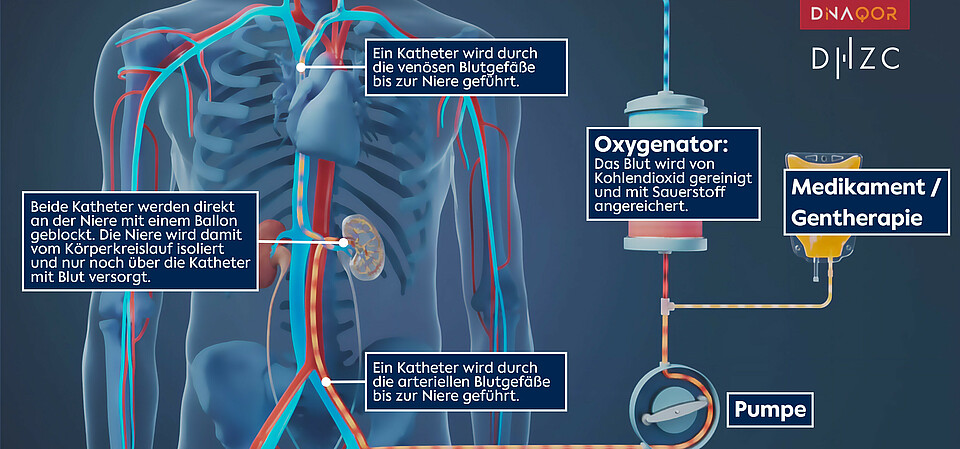
Illustration of the catheter-based “closed-loop perfusion system” - © DHZC
A team at the German Heart Center of Charité (DHZC) has developed a catheter-based system that delivers gene therapy to a single organ without affecting the rest of the body. According to a press release from Charité, the innovation could transform how genetic diseases are treated.
Traditional gene therapy faces a fundamental problem: when administered intravenously, therapeutic vectors spread throughout the bloodstream. Most of the dose ends up in the liver and spleen rather than reaching the diseased organ. To achieve therapeutic effects, doctors must use extremely high doses, leading to severe side effects and costs reaching hundreds of thousands to millions of euros per treatment.
The DHZC team, led by cardiac surgeon Professor Maximilian Emmert, partnered with Swiss biotech company DiNAQOR to create a "closed-loop perfusion system." Using two specially designed balloon catheters, they temporarily isolated a kidney from the body's circulation. The organ remained alive and functional, supplied with oxygen-rich blood through a miniature external circuit inspired by heart-lung machines. Gene therapy vectors were then introduced exclusively into this isolated system.
The results were striking. Vector concentration in the isolated kidney reached levels up to 69,000 times higher than in the rest of the body. Kidney cells absorbed the therapeutic vectors up to 75 times more effectively than with conventional intravenous delivery, while other organs like the liver and spleen remained virtually unaffected.
"We demonstrated that a single organ can be reached with precision and high efficacy in a living organism without the risks of systemic distribution," explains Emmert. The principle could eventually extend to other organs including the heart, lungs, and liver.
Professor Atta Behfar from Mayo Clinic called the technology a "potential game changer" in an accompanying editorial, noting it "bridges the gap between gene therapy's promise and its precise implementation."
Around 50,000 Germans suffer from autosomal dominant polycystic kidney disease (ADPKD), a genetic condition that could benefit from this approach. Further preclinical and clinical studies are needed before human application, but researchers see encouraging potential for treating genetic diseases more safely and affordably.